
Enabling the Connected Enterprise Execution Space
Execution Boundaries by Design, Not Convention.
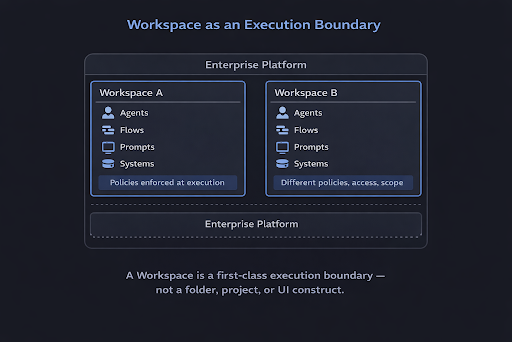
In Kaya, a Workspace is not a folder, a project, or a UI convenience. It is a first-class execution boundary.
Kaya Workspaces define where intelligence is allowed to execute, what it can access, and how it is governed across people, systems, agents, and flows.
This explicit separation prevents:
- Cross-team execution leakage
- Uncontrolled reuse of intelligence
- Policy drift across environments
- Fragmentation of enterprise AI operations
AI operates safely in enterprises only when execution boundaries are explicit, enforceable, and auditable.
Logical Separation as an Execution Primitive
Workspaces introduce logical separation at the execution layer, not just at the organizational layer.
Each iSpace Defines
- Scoped data access
- Execution permissions
- Policy constraints
- Environment isolation
Enables Enterprises to Operate
- Multiple teams
- Multiple environments (DEV / QA / PROD)
- Multiple business domains
- Multiple risk postures
on the same platform, without collapsing governance or execution consistency.
Separation is enforced by execution rules, not by convention.
Governed Prompt Authoring and Reuse
In Kaya, prompts are not free-form text artifacts. They are first-class, governed execution assets that live inside the Workspace.
The Workspace provides a Prompt Templates Library where prompts are:
- Explicitly defined
- Parameterized
- Version-controlled
- Policy-scoped
- Auditable by construction
Prompts can be generated, refined, and enhanced, but never in an uncontrolled manner.
Every prompt—whether authored manually or generated automatically—is:
- Bound to Workspace policies
- Enriched only with approved context
- Traceable to its source template
- Reproducible under the same execution fingerprint
- Prompt intelligence can evolve.
- Execution semantics do not.
This allows enterprises to scale prompt usage without duplication, drift, or loss of control.
Drag-and-Drop Intelligence Flow Authoring
Workspaces provide a visual, drag-and-drop Kaya Intelligence Flow (iFlow) builder designed for real operational use.
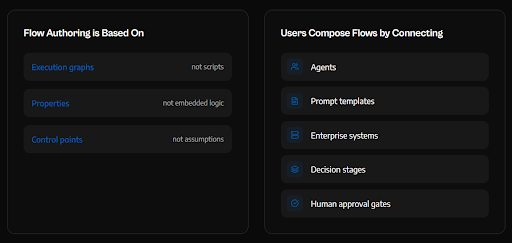
Authoring becomes an act of designing governed execution, not wiring automation.
Universal Reusability Without Execution Leakage
Kaya enables universal reuse of entities while preserving strict execution boundaries.
Reusable Entities Include
- Prompt templates
- Agents
- Connectors
- Sub-flows
- Policies
Reuse is Always:
- Explicit
- Permissioned
- Version-aware
- Policy-evaluated at execution time
- Nothing is implicitly shared.
- Nothing executes outside its authorized workspace boundary.
This enables enterprise scale without fragmentation and reuse without risk.
Decentralized Execution, Centralized Control
Workspaces allow teams to execute independently within defined boundaries, while the enterprise maintains:
- Centralized policy enforcement
- Consistent execution semantics
- Shared audit posture
- Cross-workspace visibility
This is how enterprises operate AI at scale—without silos, without chaos, without governance debt.