

Where Enterprise Intelligence Executes
The canonical unit of execution in Kaya — governed execution graphs that define how intelligence moves from intent to outcome under real-world enterprise conditions.
The Canonical Unit of Execution
In Kaya, nothing executes abstractly. Every enterprise-grade operation—AI-driven or otherwise—ultimately materializes as a Kaya Intelligence Flow (iFlow).
An iFlow is not a workflow, automation, or agent chain. It is a governed execution graph that defines how intelligence moves from intent to outcome under real-world enterprise conditions.
Uncertainty, policy, approvals, failures, and scale are treated as default execution conditions, not edge cases.
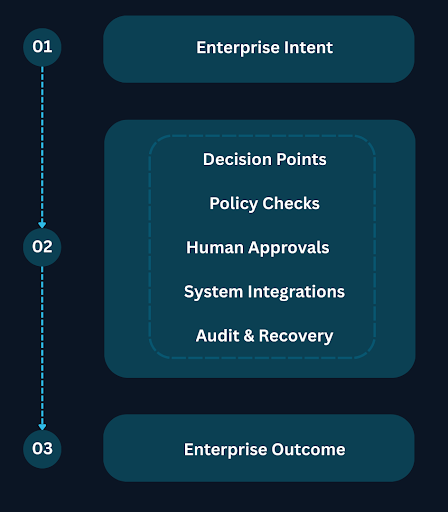
Execution Planned Before Runtime
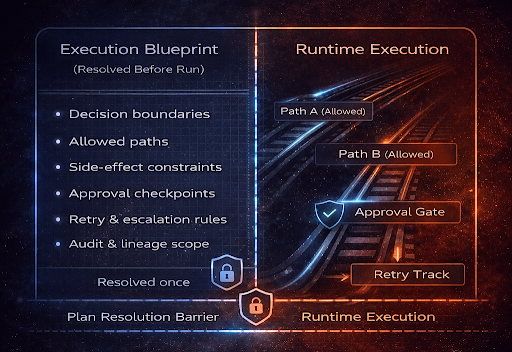
Most AI platforms allow execution behavior to emerge at runtime from prompts, agents, or scripts. Kaya rejects this model.
An Intelligence Flow is resolved as an execution plan before it runs. Before the first action occurs, an IFlow explicitly establishes:
- Decision boundaries
- Allowed orchestration paths
- Side-effect constraints
- Approval checkpoints
- Retry and escalation semantics
- Audit and lineage scope

Intelligence may vary. Execution does not drift.
Template-Governed, Enterprise-Composable
iFlows are template-driven by design, enabling standardization without rigidity. Templates encode execution doctrine, not business logic.
- Supervisor Flows — controlled delegation and agent oversight
- Plan & Execute Flows — explicit planning followed by constrained execution
- Human-in-the-Loop Flows — approval-first and override-driven execution
- Exception & Recovery Flows — deterministic handling of failures and escalations
Teams can:
- instantiate templates as-is
- adapt specific stages
Visual Authoring
Visual Authoring with Execution Discipline
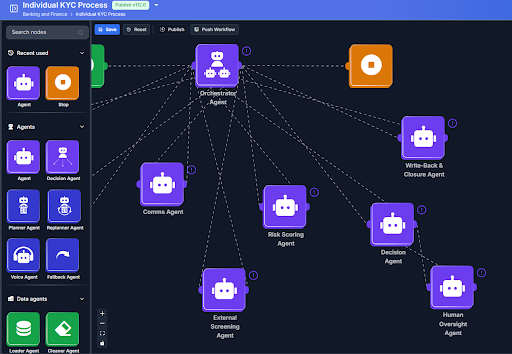
iFlows are authored using a drag-and-drop execution graph builder. This is not no-code automation. It is visual execution design with enforced control boundaries.
Within an iFlow, authors define:
- Execution stages
- Conditional transitions
- Decision checkpoints
- Retries and fallbacks
- Human approval gates
Complexity increases. Execution discipline does not erode.
Testing & Validation
Built-in Testing and Execution Validation
iFlows are testable execution systems, not black-box automations. Before promotion or production use, flows can be validated, executed in test modes, replayed, and inspected stage-by-stage.
Testing capabilities include:
- Dry-run execution without side effects
- Approval-path simulation
- Failure-path validation
- Replay of historical executions
Testing confirms how the flow behaves under real conditions—before it is trusted with real operations.
Observability
The Lowest-Level Execution and Observability Boundary
An iFlow is the lowest-level unit of execution, monitoring, and governance in Kaya.
For every execution, the platform captures:
- Inputs and outputs
- Decision lineage
- Model interactions
- Data movement
- Approvals and overrides
- Retries, failures, and escalations
Nothing executes beneath an iFlow without visibility.
Enterprise Use Cases
End-to-End Enterprise Use Case Realization
Within a single Intelligence Flow, teams can orchestrate complex enterprise operations with full governance and control.
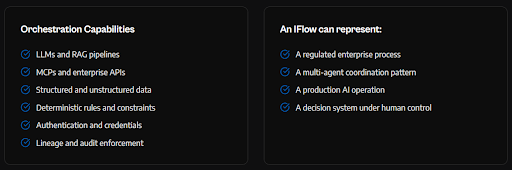
Execution is unified. Outcomes are enterprise-ready by construction.