
Governance Embedded Where Decisions Matter
In Kaya, governance is not an external process layered on top of AI execution. It is embedded directly at the points where decisions, actions, and side effects occur.
This ensures governance is enforced consistently and automatically, without relying on manual reviews, downstream audits, or operator discipline.
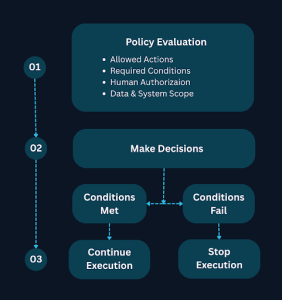
Policy as an Execution Constraint
Governance in Kaya is expressed through explicit execution constraints, not procedural rules.
Policies define:
- Which actions are permitted
- Under what conditions execution may proceed
- Where human authorization is required
- What data and systems can be accessed
These constraints are evaluated continuously as execution progresses.
If a policy condition is not satisfied, execution does not proceed. There is no bypass path.
Execution-Level Explainability with Data Lineage
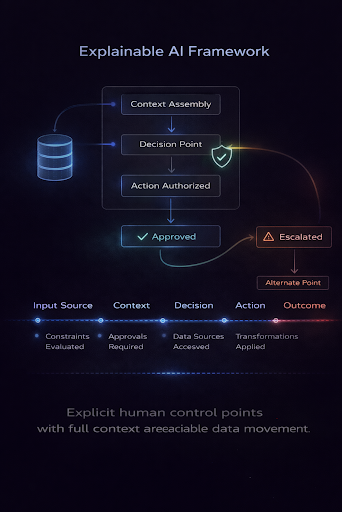
Kaya does not attempt to “explain” outcomes after the fact. It explains how execution was allowed to occur.
For every execution, the platform captures not only what decisions were made, but how data, context, and authority flowed through execution.
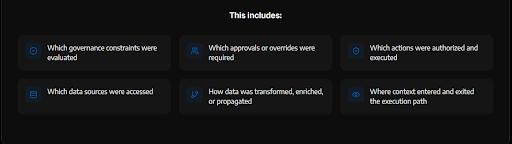
All decision points are linked to end-to-end data lineage.

Explainability emerges from governed execution paths with traceable data movement, not from post-hoc model interpretation or speculative reasoning.
What the enterprise gains is not an explanation of why a model responded a certain way, but a verifiable account of how an outcome was produced, using which data, under which controls, and with whose authorization.
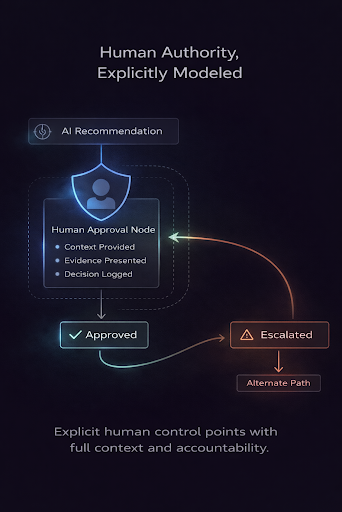
Human Authority, Explicitly Modeled
Human control in Kaya is intentional and bounded. Approvals, overrides, and escalations are modeled as explicit control points, not interrupts or exceptions.
This ensures that:
- AI recommendations never self-authorize execution
- Human decisions are made with full context
- Accountability is clearly assigned and recorded
Humans retain authority without becoming execution bottlenecks.
Audit-Ready by Default
Every execution in Kaya produces immutable governance artifacts sufficient for:
- Compliance validation
- Internal audit
- Regulatory review
- Incident investigation
No additional configuration is required to make execution auditable. Audit readiness is a consequence of controlled execution, not a logging feature.
Governance That Scales With Use
As AI usage expands across teams and use cases, governance complexity typically increases.
Kaya avoids this by enforcing governance once, at the execution layer, and applying it uniformly.
- Decentralized execution
Teams execute independently within governed boundaries
- Consistent enterprise control
Uniform policy enforcement across all use cases
- Predictable compliance posture
Known governance state at all times
Enterprises scale AI operations without accumulating governance debt.